Imagine your customer opening your app after receiving a personalized email offer. They are expecting a seamless experience.
Instead, they immediately encounter friction. They’re asked to repeat information they’ve already shared across multiple channels and departments. Then they see an offer for the item they just purchased, rather than something similar or new. And when they encounter an issue down the line, customer support doesn’t recognize their history.
Micro moments like these do not feel minor to customers anymore. They feel inexcusable. Customer expectations have changed faster than most brands can keep up. Customers now assume brands know who they are, what they need, and what’s happening right now. And they expect brands to act on that knowledge instantly.
At the same time, businesses are embracing a new era of AI. Dubbed “agentic AI,” it represents a paradigm shift where AI doesn’t just analyze or recommend products, but increasingly plans, decides, and acts through a network of agents. This creates a massive opportunity for customer experience (CX) leaders today, in particular marketers, who, according to McKinsey, are leading in AI adoption amongst business functions. But it also raises the stakes.
Because when AI moves faster than your data, systems, and processes, it exposes everything that’s broken. That tension—between rising expectations and disconnected reality—is exactly what SAP and Google Cloud are addressing together.
The marketer’s reality: ambition outpacing execution
According to recent SAP Engagement Cloud research, more than half of marketers say fragmented or outdated data prevents them from acting in the moment. Insights arrive too late. Activation requires manual stitching across tools. And even the best strategies stall before they ever reach customers.
It is clear that most organizations genuinely want to deliver great customer experiences. But fragmentation is what stands in the way of delivering connected, meaningful engagements.
On one side: Customers expect effortless, relevant, and real-time experiences. On the other hand, organizations still operate with fragmented data, siloed teams, and delayed insights.
Our latest Global Customer Engagement Index reveals that customers are increasingly frustrated: 45% say brands can’t keep up with changing expectations, and 44% say interactions feel less personal than before.
AI accelerating the engagement divide
The disconnect between what customers feel and what businesses believe is the “Engagement Divide.” Customer signals live across disconnected systems. Data arrives late or without context. Execution happens separately from insight. And while customers feel this friction immediately, many companies do not realize how disconnected their experiences truly are in their customers’ eyes. Now, AI is accelerating this divide.
Agents can generate content, launch campaigns, and optimize engagement at unprecedented speed. But when those agents act on incomplete, outdated, or fragmented data, they only exacerbate inconsistency and poor customer experiences.
When talking to our customers, it’s clear that there is no shortage of ambition when it comes to AI. In our research, 78% of brands say AI will be integral to their customer retention efforts this year. But only 46% of brands can connect their data in a way that is accessible to power AI sustainably.
The real challenge for CX leaders today is ensuring that AI has the right foundation: trusted data, unified context, and direct connection to execution.
New model for engagement built on trusted enterprise data
SAP and Google Cloud are expanding their partnership to enable a fundamentally different approach to marketing execution, one grounded in trusted enterprise data and real-time signals, accelerated with multi-agent coordination, and delivered at scale through SAP and Google’s customer engagement solutions.
SAP provides both operational truth for elements such as inventory, orders, and fulfillment status, and deep customer knowledge across customer experience interactions. Google Cloud brings additional real-time signals and analytics, along with advanced AI. Combined, they create a shared, real-time understanding of the customer, grounded in business and situational context.
At the heart of this partnership:
- SAP Business Data Cloud (SAP BDC) connects semantically rich data across the enterprise with AI to enable real-time insights and drive personalized interactions grounded in business context. This includes SAP Business Data Cloud Connect for Google BigQuery.
- Google BigQuery unlocks real-time signals across the Google ecosystem, such as geolocation, weather, and rich analytics, through bidirectional, zero-copy data access with SAP BDC, while ensuring enterprise-grade governance and security.
- SAP Customer Experience applications provide the real-time behavioral context — customer profiles, transactions, orders, service interactions, and consented engagement data.
- SAP Engagement Cloud activates enterprise data and AI insights and predictions to securely orchestrate real-time, personalized interactions across the entire customer life cycle.
With these innovations, marketers can finally move from insight to execution automatically.
To realize the full potential of agentic AI, businesses need their systems to speak the same language. By uniting SAP’s enterprise data and customer engagement platform with Google Cloud’s AI, we’re enabling marketers to move beyond simple automation to multi-agent orchestration, driving dynamic campaigns that reason and adapt to market shifts in real time.
Kevin Ichhpurani, President, Global Partner Ecosystem at Google Cloud
From prompt to performance: how agents work together for marketing
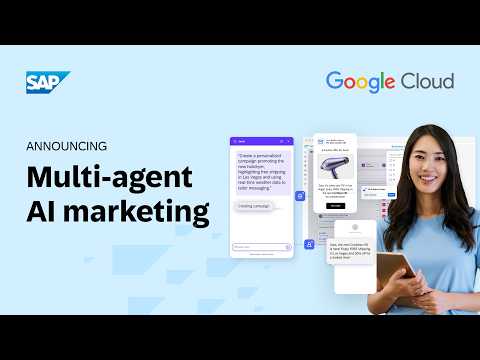
Another critical element of this new execution model is agent interoperability. Gemini Enterprise acts as a central hub for multi-agent coordination, enabling customers’ agents to securely exchange context and take action across platforms. Meanwhile, Joule acts as the engagement layer within SAP applications, executing tasks, orchestrating campaign and content workflows, and optimizing marketing outcomes. Working together, SAP and Google are enabling true multi-agent orchestration connected to trusted enterprise data.
Within this broader CX transformation, SAP Engagement Cloud is where agentic intelligence becomes operational for marketing teams. It is the environment where enterprise signals, generative media, and AI agents translate into real customer interactions and automated lifecycle journeys.
Advanced generative capabilities powered by Google Gemini models, for example, Nano Banana 2, introduce new agentic skills that help CX teams dynamically generate messaging, imagery, and campaign variations. Through assistants and agents in Joule, these capabilities become embedded directly into marketing workflows, allowing brands to adjust tone, localize content, and respond instantly to changing conditions.
It is not just content generation and personalization that are being rewired. With unified data context and interoperable agents, mobile messaging can turn into immersive conversational experiences with Google Rich Communication Services (RCS) and advertising audiences, and creative, which can continuously evolve based on real-time performance and business signals, transforming campaigns into intelligent, self-optimizing systems.
And through this multi-agent network, marketers will not need to build every step of a campaign manually. Instead, they define the goal, gain more time to focus on strategy and creativity, and let agents handle the rest.
For example, a marketer can prompt:
- “Increase repeat purchases from customers in the last 30 days.”
- “Maximize customer lifetime value while reducing campaign operational costs.”
And from there:
- Joule Agents coordinate content production, grounded in customer and enterprise data, understand business context, customer history, and constraints
- Google’s Gemini Models and agents generate creative variations, messaging, and channel-specific content
- Agents collaborate across SAP and Google Cloud to personalize, activate, and continuously optimize campaigns in real time across engagement channels and media networks
This is more than a data integration. It’s a leap forward for AI agents that can collaborate naturally and execute seamlessly. By combining SAP Business Data Cloud Connect for Google with interoperable AI agents across SAP and Google, we’re giving organizations a path from AI experimentation to AI-empowered customer experience at scale. Marketers can spend less time on manual tasks and more time shaping the customer journey.
Balaji Balasubramanian, President and Chief Product Officer, SAP Customer Experience and Consumer Industries
Clear business outcomes for marketing teams
By enabling a network of interoperable AI agents and grounding them in enterprise data and shared context across SAP and Google, organizations can achieve measurable outcomes, including:
- Faster speed-to-market through autonomous campaign and content generation
- Lower operational overhead by eliminating manual execution steps
- Always‑on optimization that continuously improves performance
- Higher ROI through relevant, timely, and consistent engagement at scale
Marketers can spend less time managing workflows and more time shaping strategy, creative direction, and customer value.
Beyond campaigns: continuous engagement at enterprise scale
While marketing is a natural starting point, this is just the beginning. Customer engagement does not live in one system or team. Engagement spans commerce, service, sales, supply chain, and operations. A brand promise made in a message must be fulfilled by inventory. A personalized offer depends on pricing, availability, and delivery. And a single customer service interaction can shape the future of customer loyalty and lifetime value.
This multi-agent model is designed to support high-value use cases across the SAP Customer Experience portfolio, laying the foundation for an AI-driven customer experience powered by trusted, unified, real-timedata.
In an AI-driven world, customer experience goes beyond any single interaction—it’s defined by every touchpoint a customer has with your company.